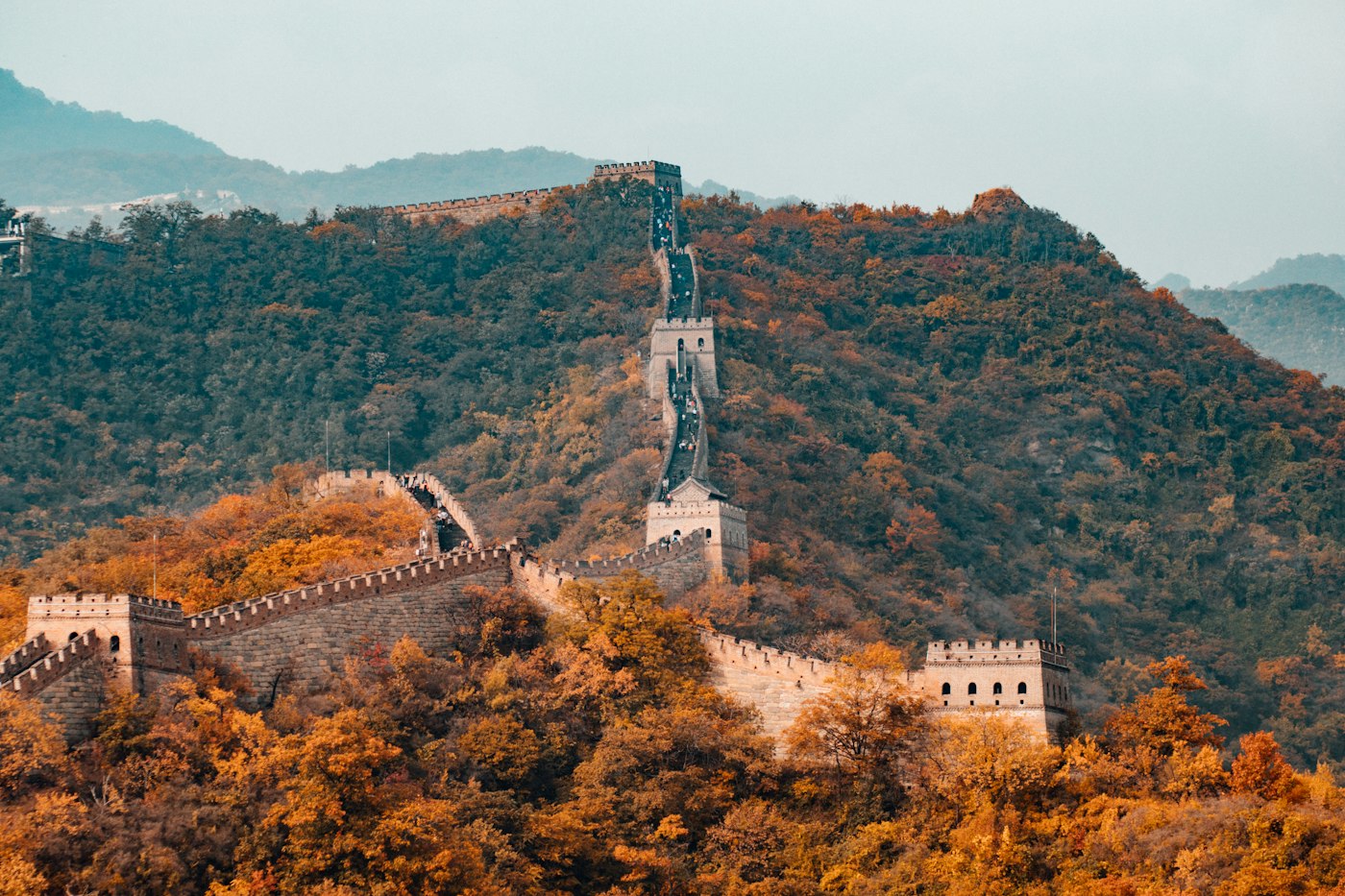
China is almost exactly as wide as the continental United States. The US has four time zones. China has one. When the sun rises in Shanghai on the eastern coast, it won't rise in Kashgar in the far west for another three hours — but both cities show the same time on their clocks. This is one of the most deliberate and politically loaded time zone decisions in the world.
How many natural time zones does China span?
Geographically, China spans approximately 73°E to 135°E longitude — a range of 62 degrees, which corresponds to about 4-5 natural time zones. Before 1949, China actually used five separate time zones, known as Kunlun, Sinkiang-Tibet, Kansu-Szechuan, Chungyuan and Changpai.
Today, every one of China's 1.4 billion people — from coastal Shanghai to the far western deserts of Xinjiang — uses China Standard Time (CST), UTC+8.
When did China switch to one time zone?
On September 27, 1949 — just days before the founding of the People's Republic of China — the new communist government declared that the entire country would use a single time zone: Beijing Time, UTC+8.
The reasoning was explicitly political. Mao Zedong's government wanted to project national unity and central control. A single clock for the entire nation was a powerful symbol — and a practical tool for coordinating a centrally planned economy, national broadcasts and military operations from Beijing.
What does single time zone mean for western China?
The effects in Xinjiang — China's westernmost region — are dramatic. Beijing Time is approximately 3 hours ahead of the region's actual solar time. This means:
- The sun doesn't rise in Kashgar until 9–10 AM in winter
- It stays light until 11 PM in summer
- Solar noon happens at around 3 PM on the clock
Many Uyghur residents in Xinjiang informally use "Xinjiang Time" — UTC+6 — in their daily lives, setting their clocks 2 hours behind Beijing Time. This creates a dual-time reality where official government functions run on Beijing Time and local life runs 2 hours behind.
Could China ever split into multiple time zones?
It's politically unthinkable in the current climate. The single time zone is deeply tied to the Communist Party's narrative of national unity and centralized governance. Any move to create a separate Xinjiang time zone would be seen as an acknowledgment of the region's distinct identity — something Beijing strongly resists.
From a practical standpoint, China's high-speed rail network, national TV broadcasts and financial systems all run on Beijing Time. The infrastructure of daily life has been built around the single time zone for 75 years.